
978-1-956474-89-3
Pub Date: June 30, 2026
Author: M. J. Moore
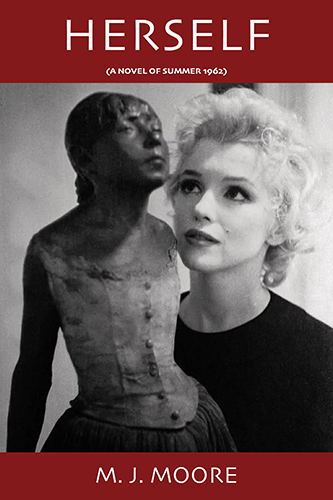
 HERSELF, a work of biographical fiction, is the story of two individuals at crossroads. Both are starting their lives anew, racked with personal insecurities. Gradually, they bond because one of them employs the other in a unique way. Who has the power to hire? That’s Marilyn. She wants to compose her autobiography, to speak her truth about varied struggles in her career. However, organizing ideas, outlining chapters, and writing a whole book have her stymied. She hires Eddie Leo as a researcher and potential co-author. They thrive on the same types of music, although she’s fourteen years older than he is. They both love to read books. Their rapport is not merely transactional. There’s more than a job or a boss at issue.
This story unfolds in June and July of 1962. She hires him two days after her 36th birthday. Less than a week later, Marilyn’s studio fires her. Eddie Leo is 22, a new college graduate, and amazed by the grit she manifests choreographing a media war with her studio and getting herself rehired later in July. Everything ends in August.
Our narrator’s name is Eddie Leo Shaughnessy. Her name is Marilyn Monroe. HERSELF (A Novel of Summer 1962) is their story.
“Immersive and confident … the period details are well chosen and grounded … It feels cinematic and intentional, with a strong grasp of how fame distorts the space around a person … HERSELF is atmospheric literary fiction that explores fame, interior life, and cultural myths.”— Laurie Gwen Shapiro, New York Times bestselling author of The Aviator and the Showman: Amelia Earhart, George Putnam, and the Marriage That Made an American Icon
“M.J. Moore’s keen insight and empathy elevate HERSELF (A Novel of Summer 1962) in the crowded field of Marilyn books. His Monroe is neither a victim nor an object for the male gaze to feast on. Moore offers us an intelligent, visionary woman aware of her place in the world and determined to change it — to control her own narrative, claim a voice, and leave a legacy for other women in her own industry and beyond. That she was in a race against a clock she didn’t know was ticking, doesn’t alter the magnitude of her attempt or her accomplishment in that summer of ’62. I think Monroe would have rejoiced at Moore’s respect and friendship. This is the Monroe we have not known before, on the brink of the second wave of feminism she would not live to see. Thank you, M.J. Moore, for giving this Marilyn to us. She is so clearly a woman I deeply want to know.” —Laurel Brett, Prizewinning author of The Schrodinger Girl
“Moore’s novel, like the best biographies of Monroe, portrays an alert, canny woman coming into her own, occasionally disrupted by sedatives and stimulants. In fascinating conversations, Monroe and Eddie Leo discuss song lyrics, showing off her grasp of musical structure … Absent from this absorbing novel are the Kennedys and any whiff of conspiracy theories about Monroe’s death … In his re-imagining of the final months of the screen icon’s life, M. J. Moore avoids conspiracy theories, instead focusing on her fight for control of her career.” —Carl Rollyson, the New York Sun
 M. J. Moore is the author of two biographies (Star-Crossed Lovers: James Jones, Lowney Handy and the Birth of From Here to Eternity and Mario Puzo: An American Writer’s Quest) and a novel (For Paris ~ With Love & Squalor). Moore’s writing has appeared in The Village Voice, The New York Daily News, Literary Hub, The International New York Times, and The Paris Review ~ Daily. He lives in New York City.

